Vedha Śālā Ujjain — Astronomical Instrumentation
The Gnomon
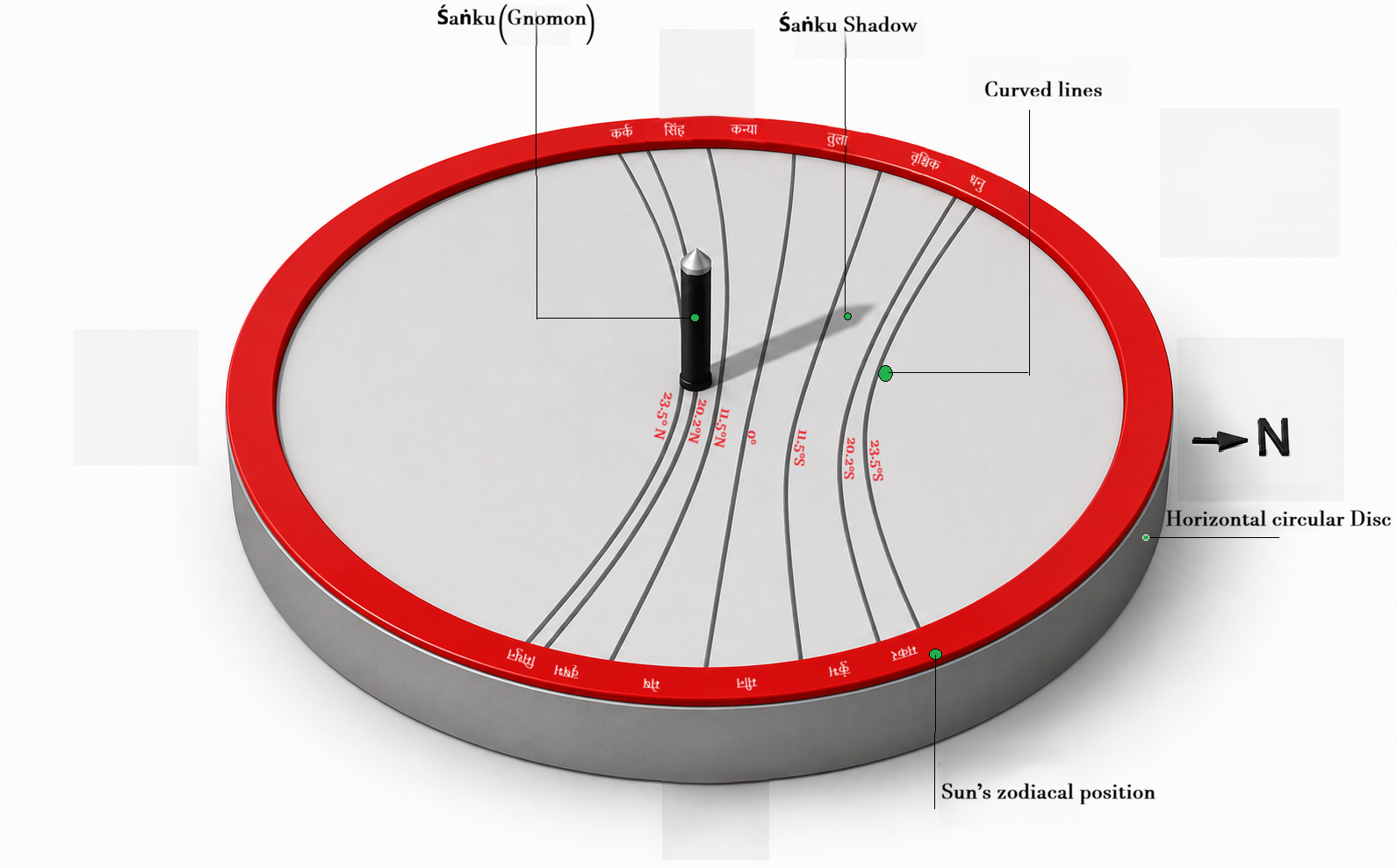
The Śaṅku Yantra is an ancient astronomical instrument renowned for its accuracy and simplicity. Using the Sun’s shadow, it can precisely determine the Sun’s zodiacal position, solar declination, local time, seasonal transitions, and the length of the day. For centuries, it has served as an essential tool for astronomical observations and timekeeping.
Structure and Components
The structure of the Śaṅku Yantra is remarkably simple yet scientifically sophisticated. It consists of a circular horizontal platform at the center of which stands a vertical rod known as the śaṅku (gnomon). This rod is positioned perpendicular to the plane of the platform and serves as the principal observational element of the instrument.
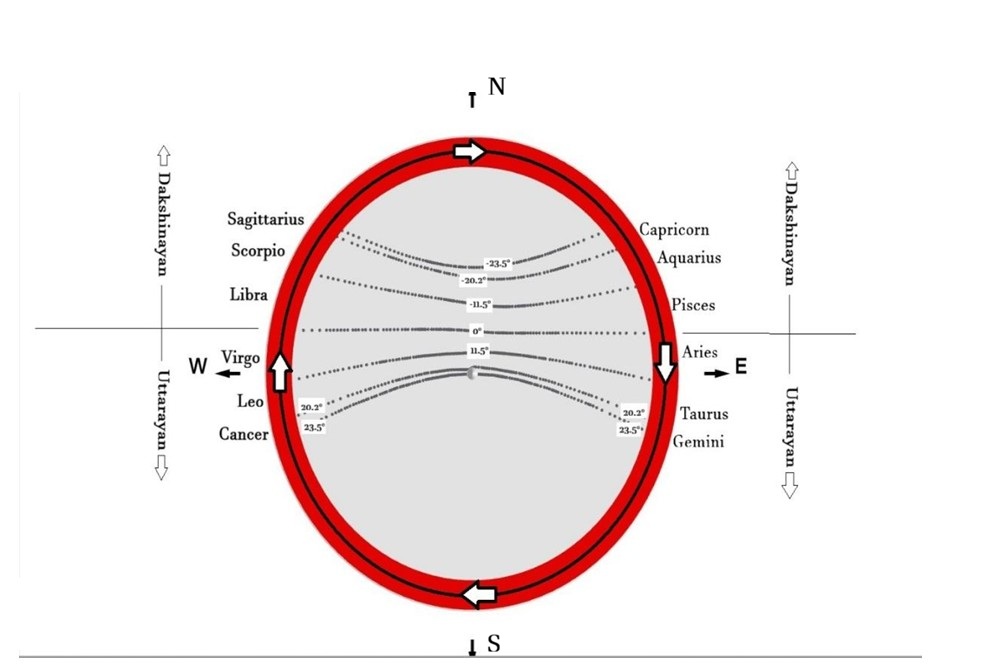
Engraved on the circular platform are seven curved lines aligned along the east–west direction. These curves correspond to the zodiacal division points marked on the circumference of the platform. In essence, they indicate the Sun’s transition through the twelve zodiac signs, marking its movement from one sign to the next during the course of the year.
The position and shape of these curved lines vary according to the height of the śaṅku as well as the latitude and longitude for which the instrument is designed. Throughout the day, the shadow cast by the śaṅku falls upon the circular platform. By observing the path traced by the tip of the shadow relative to the curved lines, astronomers can determine the Sun’s declination, tropical zodiac sign, date of the year, equinoxes, altitude, the transitions of Uttarāyaṇa and Dakṣiṇāyana, and the changing seasons with remarkable accuracy.
Working Principle
The Śaṅku Yantra installed at the Vedhaśālā, Ujjain, is an important instrument that reflects the depth of ancient Indian astronomical knowledge, geometry, and the study of the Sun’s motion. Its working principle is based on the scientific analysis of the Sun’s apparent annual movement relative to the Earth and the shadows produced by that motion.
When observed from Earth, the Sun appears to travel along a fixed path across the celestial sphere throughout the year. This path is known as the Ecliptic. The ecliptic is divided into twelve equal sections, forming the zodiac, with each section representing the Sun’s annual position during a particular period of the year.
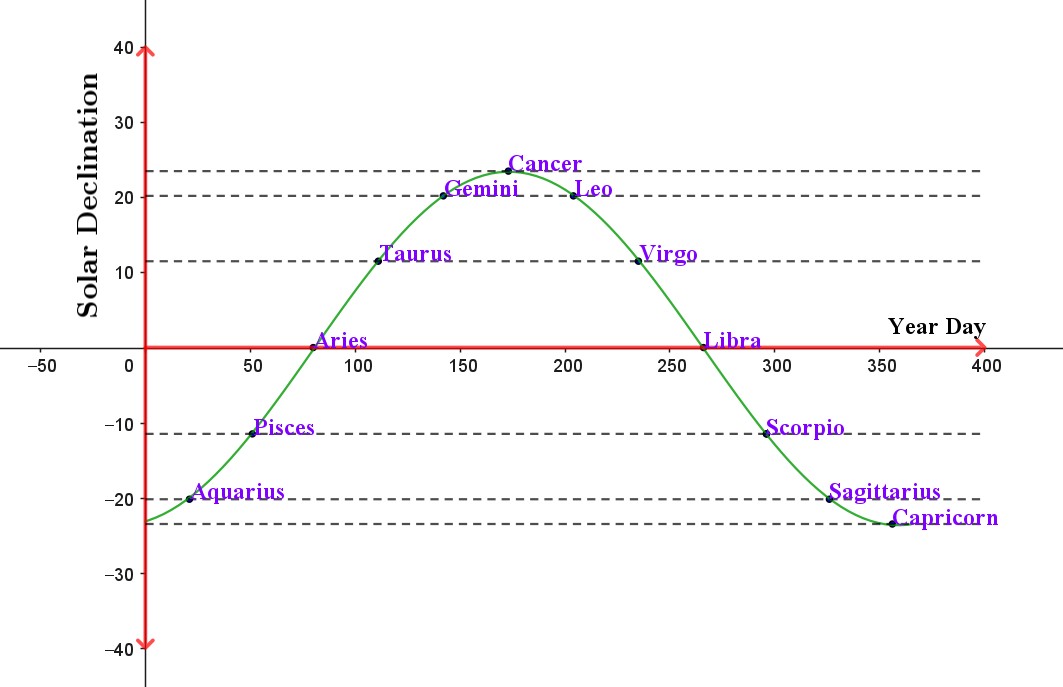
Over the course of a year, the Sun appears to shift northward and southward by approximately ±23.5° relative to the Earth's celestial equator. This angular displacement is known as the Solar Declination (Krānti-aṁśa). Variations in solar declination are primarily responsible for seasonal changes, the transitions of Uttarāyaṇa and Dakṣiṇāyana, and the changing durations of day and night.
The Śaṅku Yantra consists of a vertical rod, or gnomon (śaṅku), mounted on a circular or level platform. As the Sun’s position changes throughout the day and year, both the length and direction of the shadow cast by the gnomon continuously vary.
1. At the Summer Solstice, the noon shadow is the shortest of the year.
2. At the Winter Solstice, the noon shadow reaches its maximum length.
3. During the Equinoxes, the behavior of the shadow exhibits a distinctive symmetry.
Throughout the year, whenever the Sun lies at the boundary between two zodiac signs, the tip of the gnomon’s shadow traces a characteristic path across the platform. These paths are permanently marked as curved lines on the instrument. Each curve represents a specific solar declination, while the regions between adjacent curves correspond to different zodiacal positions of the Sun. The following illustration demonstrates the variation of the Sun’s declination on different days of the year.
By studying these marked curves and the direction of the shadow, the following astronomical parameters can be accurately determined:
Thus, the Śaṅku Yantra is not merely an instrument for measuring time; it is a sophisticated scientific device that demonstrates the Sun’s apparent motion, the inclination of the Earth’s axis, and the principles of celestial geometry. It stands as an outstanding example of the advanced astronomical knowledge and observational traditions developed in ancient Indian observatories.
Observation method
Observe the following components of the instrument carefully:
By observing the position of the tip of the Śaṅku’s shadow relative to these curved lines on different days of the year, one can determine various astronomical parameters, including time, the Sun’s tropical zodiac sign, solar declination, seasons, and the transitions of Uttarāyaṇa and Dakṣiṇāyana.
The above illustration shows the circular platform of the Śaṅku Yantra and the seven marked curved lines, numbered from Line 1 at the bottom to Line 7 at the top. The figure also indicates the corresponding values of solar declination and the Sun’s tropical zodiac signs.
Note:
Interactive Simulation
Follow the steps below to observe the Śaṅku Yantra Simulation:
Calibration Model
This tool allows you to generate a calibrated template of the Śaṅku Yantra for your location by plotting the required curved lines on the instrument’s base. Follow the steps below: