Vedha Śālā Ujjain — Instrument Study
The Equatorial Dial
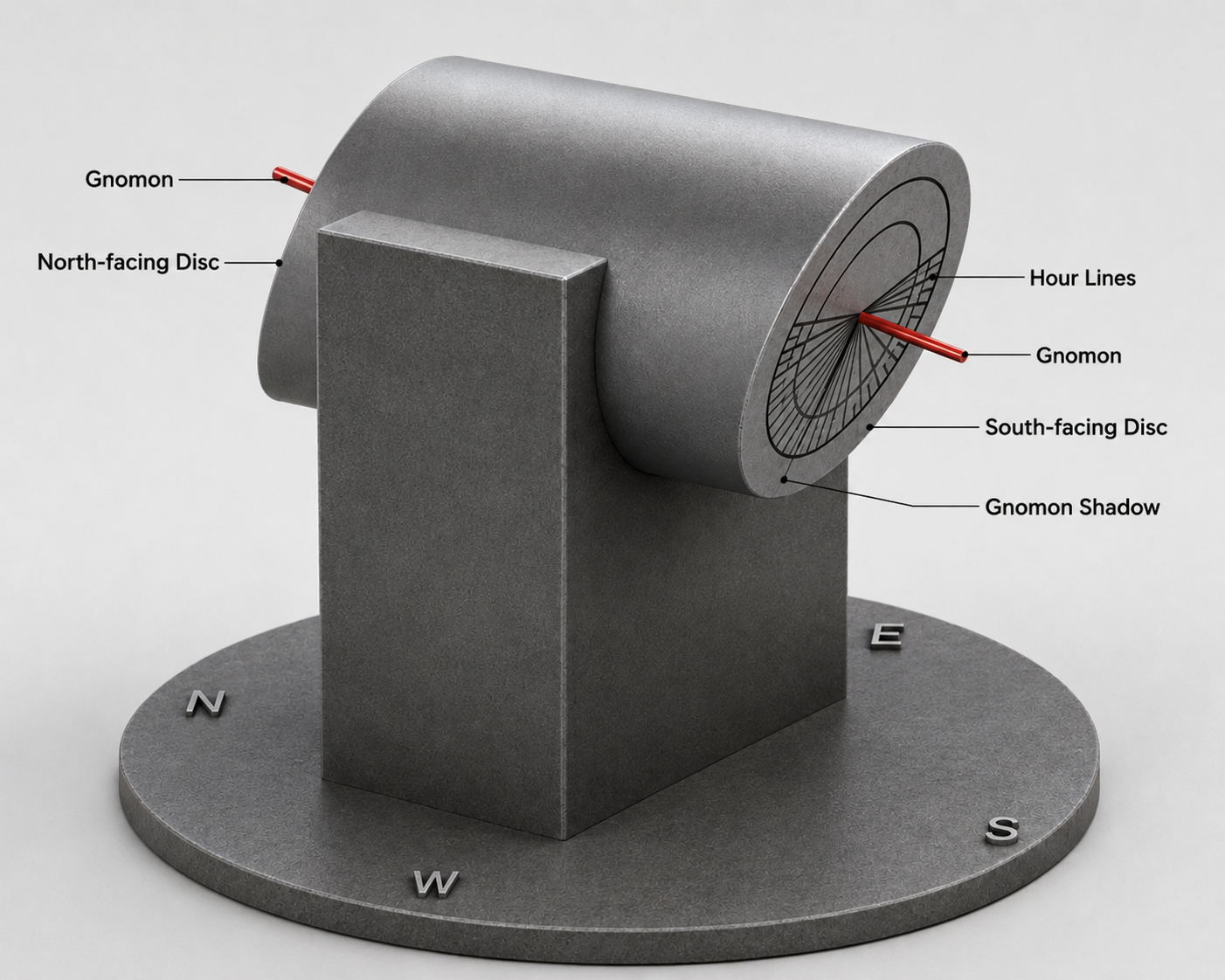
The Nadi Valay Yantra is a unique and scientifically important astronomical instrument at Vedh Shala Ujjain. It is an Equatorial Ring Dial consisting of two circular plates—one north-facing and the other south-facing. The instrument is used to determine Local Solar Time and to observe the Sun's movement during the Uttarayana and Dakshinayana periods. Its design reflects the remarkable precision and sophistication of traditional Indian astronomical practices.
Structure and Components
The South-facing Disc is a circular plate oriented towards the south and installed parallel to the local equatorial plane. When the Sun lies south of the celestial equator (negative declination), the shadow cast by the gnomon falls on this disc. The position of the shadow is then used to determine the Local Solar Time. ...
The North-facing Disc is oriented towards the north and, together with the South-facing Disc, represents the Earth's equatorial plane. When the Sun lies north of the celestial equator (positive declination), the shadow cast by the gnomon falls on this disc, allowing the local time to be determined.
A gnomon is mounted at the centre of the circular discs and is aligned parallel to the Earth's axis of rotation. Consequently, it makes an angle with the horizontal plane equal to the local latitude. For example, at Ujjain, this angle is approximately 23°11′, corresponding to the city's latitude.
The gnomon is directed towards the North Celestial Pole. Therefore, when viewed along its northern end, it points approximately towards Polaris (the Pole Star). This alignment ensures that the Nāḍī Valaya Yantra remains parallel to the Earth's rotational axis and forms the basis of its timekeeping capability.
As the Sun undergoes its apparent daily motion across the sky, the gnomon's shadow moves uniformly across the circular discs. In addition, the Sun's declination changes continuously throughout the year, causing the position of the shadow to shift seasonally. As a result, the shadow falls alternately on the North-facing and South-facing discs at different times of the year. The position of the shadow relative to the engraved hour lines is used to determine the Local Solar Time.
Both discs are marked with hour lines at regular intervals of 15°, radiating from the centre. This graduation is based on the fact that the Sun's hour angle changes by 15° per hour due to the Earth's rotation. Smaller subdivisions between the hour lines provide minute-level indications for more precise time readings.
The entire instrument is mounted on a robust stone or masonry plinth, which ensures its stability, proper alignment, and long-term observational accuracy.
Working Principle
From the Earth's perspective, the Sun appears to move west to east along the ecliptic throughout the year, causing its declination to change continuously. On any given day, the Sun's apparent daily path can be considered a circular trajectory around the Earth's axis of rotation.
The Earth rotates on its axis from west to east, completing one full rotation in approximately 24 hours. As a consequence, the Sun appears to move across the sky from east to west. Since the Earth rotates through 360° in 24 hours, the Sun's apparent angular motion is 15° per hour (360° ÷ 24), or 15 arcminutes per minute. In other words, to an observer on Earth, the Sun appears to complete a full 360° circuit around the Earth's rotational axis every 24 hours....
The operating principle of the Nāḍī Valaya Yantra is based on this apparent angular motion. The circular discs are installed parallel to the local equatorial plane, while the gnomon is aligned parallel to the Earth's rotational axis. Because of this alignment, the gnomon points towards Polaris (the Pole Star), indicating the instrument's correct axial orientation. Furthermore, the angle that the gnomon makes with the horizontal plane is equal to the local latitude of the observing site.
As the Sun moves across the sky, the shadow cast by the gnomon traverses the circular discs with a uniform angular motion corresponding to the Sun's hour angle. Since the hour angle changes at a rate of 15° per hour, the discs are graduated at equal 15° intervals. The Local Solar Time is determined directly from the hour line intersected by the gnomon's shadow.
When the Sun is close to the celestial equator (declination ≈ 0°), the daily path of the gnomon's shadow is more symmetrical and extends over a larger region of the disc. As the Sun's declination increases, either northward or southward, the shadow path gradually shifts and occupies a smaller portion of the disc. Consequently, the position of the shadow path also provides information about the Sun's declination.
Because the Sun's declination changes continuously throughout the year, it alternately lies north and south of the celestial equator. When the Sun is north of the celestial equator (positive declination), its rays predominantly illuminate the North-facing Disc, and time is read from that disc. Conversely, when the Sun is south of the celestial equator (negative declination), its rays fall primarily on the South-facing Disc, and time is determined from that side.
During the equinoxes, when the Sun's declination is approximately 0° and it lies on the celestial equator, sunlight falls along the plane between the two discs. In this configuration, both the North-facing and South-facing discs together enable continuous and accurate measurement of Local Solar Time throughout the year.
Thus, the Nāḍī Valaya Yantra is essentially an Equatorial Sundial that utilizes the Sun's hourly angular motion, produced by the Earth's rotation, together with the seasonal variation in the Sun's declination, to determine time and infer the Sun's astronomical position with remarkable precision.
Observation method
Interactive Simulation